
honey onion cough syrup is a natural folk remedy that soothes sore throats and clears mucus. Made with simple ingredients, this homemade syrup offers antibacterial and anti-inflammatory benefits. Try this easy recipe tonight!
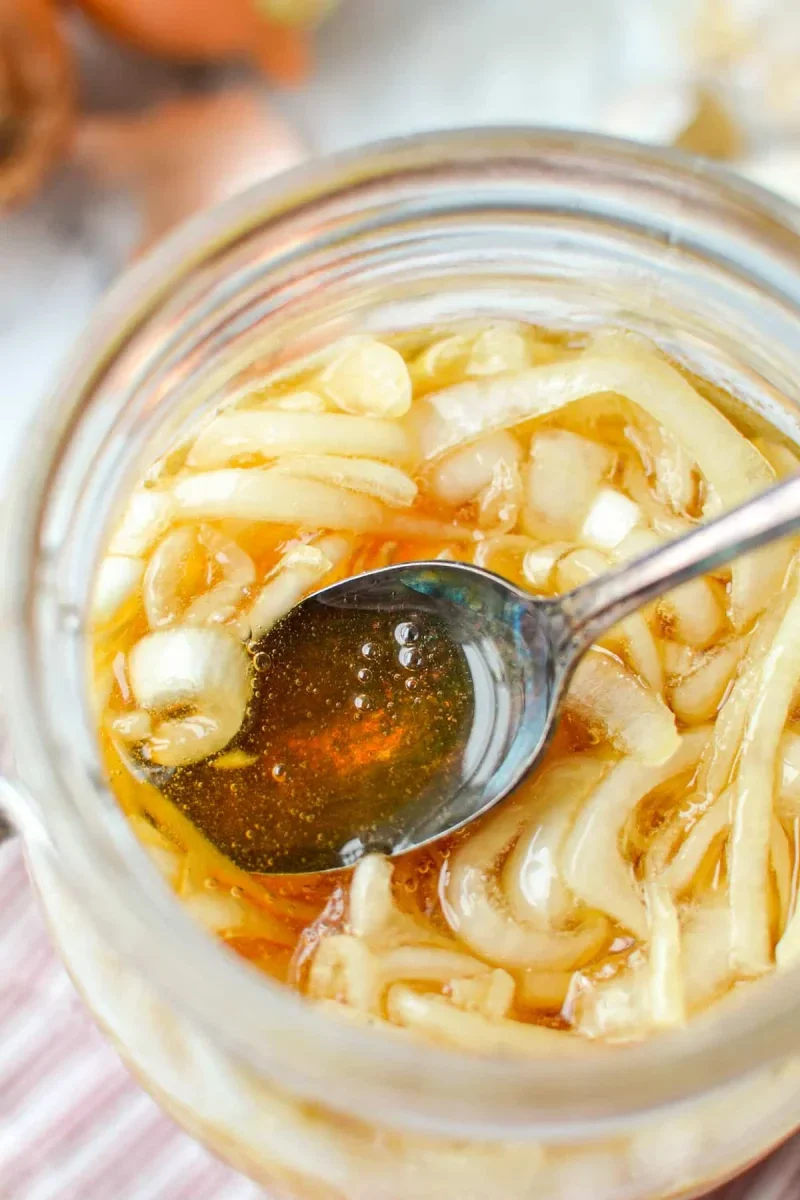
See the onions and garlic infused in the golden honey for maximum potency.
Easy Honey Onion Cough Syrup Recipe That Actually Works
Honey Onion Cough Syrup
This easy recipe for Honey and Onion Cough Syrup is a old folk remedy for cough and colds. Helps to soothe a sore throat and clear mucus.
This easy recipe for Honey and Onion Cough Syrup is an old folk remedy for cough and colds. It combines the well known benefits of onion and honey to create a simple, affordable homemade cough syrup to help sooth a sore throat and clear excess mucus.
This simple, timeless recipe for Honey and Onion Cough Syrup was first introduced to me in the book Medicinal Herbs by Rosemary Gladstar. It’s a folk medicine recipe that has been passed down throughout the generations, and a quick look online shows you that something similar has been made for countless generations in cultures all over the globe.
While many traditional recipes call for steeping the raw onions in with the honey for several days, Rosemary’s is different in that she warms the honey ever so slightly, allowing the onions to soften and release their beneficial sulfur compounds.
I add a little garlic to my version (although it’s optional), as well as give you more structured ingredient amounts and recipe times so it’s easy to create in your own kitchen.
Reasons to Love This Recipe
- It’s made with simple, household ingredients that have great healing properties.
- Easy enough for a beginner to make.
- Tastes surprisingly good, making it a bit easier to give to sick kids.
- A powerful folk remedy that has been used for generations and generations.
Honey and Onion Cough Syrup Benefits
Both honey and onions have been used for millennia to cure common ailments such as cough, cold, and respiratory issues. The use of these two household ingredients in folk remedies is almost as old as time itself, and the combination is still used to this day.
Since honey and onion cough syrup contains both honey and onion, it combines the benefits of each of these into one (surprisingly) delicious syrup that is easy to make.
Here are just a few benefits:
- Honey is antibacterial, anti-inflammatory, and a powerful antioxidant.
- Honey soothes a sore and tired throat.
- Onion contains the antioxidant quercetin, which fights inflammation in the body.
- Onion is high in sulfur compounds (as is garlic), which has been shown to help with a variety of health issues.
- Since onion is an expectorant it helps clear mucus, which is common with a cough.
- Onions have electrolytes, which is essential for keeping hydrated during an illness.

How to Make Cough Syrup with Onion and Honey

- To get started, simply peel and cut your onions in half. Then slice them into thin half-moon shapes. Add them to a medium sized pot, then add in some chopped garlic (2-3 cloves) if desired.
- Add in the honey, drizzling in enough to completely cover the onions. They do not need to be submerged under an inch or more of honey, just enough that all of the onions are coated and covered.
Warming the Honey and Onions
- Place your pot on the stove, and heat over low heat until the onions are very soft and slightly mushy. Stir occasionally to encourage even heating – the mixture should never feel hot to the touch, just warm.
- It will take around 1-2 hours for your onions to soften, and you may need to increase the heat ever so slightly if the onions are not losing their shape within the first 30 minutes or so.
- Once the onions are soft and slightly mushy, taste your syrup to check the flavor. It should taste pleasantly of honey with just a touch of onion – it’s surprisingly tasty!
- Allow it to cool to room temperature completely before transferring to a jar for storage – this prevents condensation and moisture in the jar.

Dosing Recommendations
At the onset of symptoms: Take ½-1 teaspoon (2.5 – 5 milliliters) every 1-2 hours.
Treating an active cough: 1 teaspoon (5 milliliters) 3-4 times per day until you have recovered.
Storing and Shelf Life
- Once your honey onion cough syrup has cooled to room temperature, transfer it to a clean jar with a lid. This can be a swing-top jar or a wide mouth mason jar with a plastic lid. Just make sure it’s nice and clean to ensure the longest storage possible of your homemade cough syrup.
- If you leave the onions in the syrup you can expect for this to store in the fridge for up to 1 week.
- If you want it to store for 2-6 months, just carefully remove the onions using a clean utensil. Then transfer to the fridge and watch carefully for signs of spoilage such as an off smell, color, or mold growth. Discard if there are any signs of spoilage.

Honey and Onion Cough Syrup
132kcal
Ingredients
- 2 medium onions (peeled and sliced into half-moons) 2-3
- 2 cloves garlic (roughly chopped (optional))
- 2 cups raw honey 2-3
Method
- Add the sliced onions to a medium heavy-bottomed saucepan or dutch oven, along with the chopped garlic (if using).
- Add enough honey to cover the onions. They do not need to be entirely submerged, but the honey level should be as high as the onions.
- Turn the burner on low and allow the onions and garlic to soften, stirring occasionally.
- Cook on low heat until the onions are soft and slightly mushy, about 1-2 hours. Stir occasionally to encourage even heating.
- If your onions are still not very soft, you can increase the heat slightly to encourage them to release their juices. The goal is to keep the heat low to preserve the enzymes and benefits of honey.
- Once the honey has been infused, turn off the heat and allow it to cool to room temperature.
- Place the honey onion cough syrup in a glass jar, and top it with a lid once the honey is no longer warm.
- Store in the refrigerator for up to 1 week with the onions and garlic, or strain off the onions and garlic if you would like to store for 2-6 months. Discard if there are any signs of spoilage such as mold or an off smell.
- Take 1/2 - 1 teaspoon every 1-2 hours at the first signs of a cold. If you’re treating a cold that has already started, take 1 teaspoon 3-4 times per day.
Nutrition info is automatically calculated as an estimate — actual values may vary. Always check your ingredient labels for the most accurate results!
Notes
IMPORTANT: Honey is not safe for babies under 1 year of age.
Storage: Transfer to a clean jar. Store in the refrigerator for up to 1 week with the onions and garlic, or 2-6 months if the onions and garlic are removed.
Room temperature: Some people prefer to allow their onions and honey to steep at room temperature for 1-2 days. I don't recommend this (because of the risk of botulism), but many people make their syrup this way.
Adapted from: Medicinal Herbs: A Beginner’s Guide by Rosemary Gladstar
With ginger: Add 2-3 teaspoons of freshly grated ginger to the onions and garlic before topping with honey.
With lemon: When making honey syrups I like to avoid adding liquid when possible, as this can shorten the shelf life. If you want to add lemon to your honey onion syrup, I’d recommend setting aside 2-3 days worth and adding fresh lemon juice to taste to the small amount. This will help prolong the storage of your main batch.
Without honey: You can try using maple syrup or glycerin in place of the honey in this recipe.
Storage: Transfer to a clean jar. Store in the refrigerator for up to 1 week with the onions and garlic, or 2-6 months if the onions and garlic are removed.
Room temperature: Some people prefer to allow their onions and honey to steep at room temperature for 1-2 days. I don't recommend this (because of the risk of botulism), but many people make their syrup this way.
Adapted from: Medicinal Herbs: A Beginner’s Guide by Rosemary Gladstar
With ginger: Add 2-3 teaspoons of freshly grated ginger to the onions and garlic before topping with honey.
With lemon: When making honey syrups I like to avoid adding liquid when possible, as this can shorten the shelf life. If you want to add lemon to your honey onion syrup, I’d recommend setting aside 2-3 days worth and adding fresh lemon juice to taste to the small amount. This will help prolong the storage of your main batch.
Without honey: You can try using maple syrup or glycerin in place of the honey in this recipe.
Private Notes
Tried this recipe?
Let us know how it was!Variations and Substitutions
With lemon: When making honey syrups I like to avoid adding liquid when possible, as this can shorten the shelf life. If you want to add lemon to your honey onion syrup, I’d recommend setting aside 2-3 days worth and adding fresh lemon juice to taste to the small amount.
This will help prolong the storage of your main batch.
With ginger: Add 2-3 teaspoons of freshly grated ginger in with the garlic and onions. Ginger has been shown to reduce nausea, and is also anti-inflammatory.
Without honey: If you have babies under 1 year at home (but older than 6 months), you may be wondering if there is a way you can make honey and onion cough syrup without honey. I haven’t tried it myself, but popular substitutes for honey in herbal remedies include maple syrup, glycerin, and brown sugar.
Be sure to check with your healthcare provider before giving it to children.
Note that if you use maple syrup or glycerine, your storage time is reduced as well. I would recommend 2-3 days with the onions in the syrup, and up to 2 weeks without the onions as a starting place.
Discard if there are any signs of spoilage such as an off color, presence of mold or growth, or an off smell.